


Message from the Batch

“We are committed to learning, growing, and contributing to the excellence of Bangladesh Railway.

This portal is our shared platform to stay informed, organized, and connected as we embark on our professional journey.”

Welcome to 27th BCS (1st Result) Railway Cadre

This website is dedicated to the officers of the 27th BCS (1st Result) Railway Engineering and Traffic & Commercial Cadres who have joined Bangladesh Railway.

The 27th BCS examination was a landmark event for Bangladesh Railway. While the first viva-voce exams were conducted on 21 January 2007, the results were later cancelled by the caretaker government. Following a second viva-voce in July 2007, results were published in September 2008, through which 3,229 candidates were appointed.

Candidates who had earlier passed the first viva-voce challenged the cancellation of their results before the High Court. After a long legal process, justice prevailed, and on 20 February 2025, the Appellate Division of the Supreme Court reinstated a High Court verdict originally delivered on 11 November 2009 and directed the appointment of the 1,137 candidates who had passed the first viva-voce of the 27th BCS with full seniority. The court also ruled that candidates appointed through the second viva-voce would continue in service, with seniority to be determined in accordance with applicable laws and rules.

Among them, five officers from the Railway Cadres — Md. Mohiul Islam, Md. Zakir Hossain, Md. Jasud Khan, AHM Salim Reza, and Md. Abul Kalam Azad officially joined Bangladesh Railway on 01 January 2026, marking a new chapter of professional service and excellence.

This is a step toward structured learning, institutional memory, and professional connection within Bangladesh Railway.

Ministry of Railways

Among the public transport modes of the country, Bangladesh Railway is the largest state transport sector of the government. The first railway in this country was started on November 15, 1862 with the construction of the Darshana-Jagati railway line. Currently, the 2877 km railway line network of Bangladesh Railway is connected to 44 districts of the country. Before 1947, the railway was operated by the Railway Board in undivided India. In 1973, the activities of the board were abolished and it was merged with the Ministry of Communications. Later, the Railways Department was formed in 1982. The Secretary of the Railways Department served as the DG cum Secretary. In 1995, the Bangladesh Railway Authority (BRA) was formed. However, the activities of the formed BRA were not continued later. During the period 1996-2003, initiatives were taken to reform the institutional structure of Bangladesh Railway with the funding of ADB. After that, the activities of Bangladesh Railway were managed by the Roads and Railways Department under the Ministry of Communications. In response to the needs of the people and the demands of the times, the government created a new department under the Ministry of Communications under the name of Railways Department as per the Cabinet Division Notification No. 04.423.022.02.01.003.2011.40 dated 28-04-2011. Later, the Ministry of Railways was formed under the Cabinet Division S.O. No. 361 Act/2011 dated 04-12-2011.

Bangladesh Railway, a principal transportation agency of the country, is a government-owned and government-managed organization. It covers a length of 2955.53 route kilometers, employing a total of 25,083 regular employees. As the railway is a very important mode of inland transport, linking the entire length and breadth of the country, its healthy growth naturally contributes to the economic development of the country. Till June 2, 1982, the management and development of the railway was vested with a Railway Board, comprising a chairman and four members. But, for administrative convenience and operational reasons, the Railway Board was abolished with effect from June 3, 1982, and the function of the Railway Board was vested with the Railway Division of the Ministry of Communications, with the Secretary of the Division working as the Director General of Bangladesh Railway.

Till June 2, 1982, the management and development of the railway was vested with a Railway Board, comprising a chairman and four members. But, for administrative convenience and operational reasons, the Railway Board was abolished with effect from June 3, 1982, and the function of the Railway Board was vested with the Railway Division of the Ministry of Communications, with the Secretary of the Division working as the Director General of Bangladesh Railway.
For the same purpose, the railway bifurcated into two zones, East & West, under the administrative control of two general managers, who are accountable to the Director General of Bangladesh Railway. Subsequently, on August 12, 1995, the day-to-day operation of the railway was separated from the ministry and entrusted to a director general drawn from the railway professionals. For policy guidance, a 9 member Bangladesh Railway authority was formed with the Minster,  Ministory of Communications as its Chairman. The Director General is assisted by the Additional Director General and the Joint Director General to perform all administrative and policy making jobs.

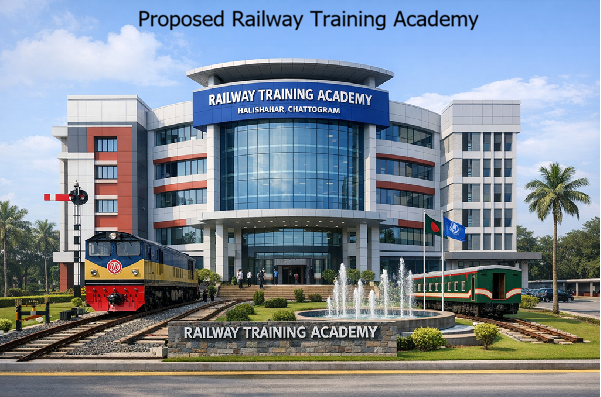
The Railway Training Academy in Bangladesh, commonly referred to as the Bangladesh Railway Training Academy (RTA), is the primary institution responsible for training officers and staff of Bangladesh Railway (BR). It plays a vital role in ensuring safe, efficient, and skilled operations across the national railway network.

The Railway Training Academy (RTA), located at Halishahar in Chattogram, is the central hub for training Bangladesh Railway (BR) personnel. It conducts a variety of programs to build and upgrade skills for officers, supervisory staff, and other employees across different departments.

Today, the Railway Training Academy at Halishahar, Chattogram, stands as a key pillar of Bangladesh Railway’s human resource development, helping sustain and modernize one of the country’s oldest and most essential transportation systems, which traces its roots back to the 1860s in the region.

The academy offers both foundational (initial/induction) training for new recruits and ongoing/refresher courses for serving staff. It also coordinates with four Workshop Training Units (WTUs) at Pahartali (Chattogram), Dhaka, Parbatipur, and Ishurdi, mainly for mechanical and locomotive-related practical training.

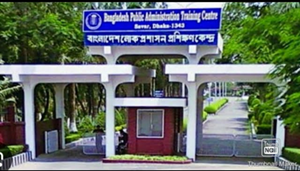
A centre committed to excellence and a premier regional hub dedicated to provide effective, inclusive and self-mandated and bespoke training for civil servants, the Bangladesh Public Administration Training Centre (BPATC), is the apex public sector training institute in Bangladesh-meeting the challenges of the 21st century. The centre offers innovative training courses across subjects, from public administration and governance to leadership training, Sustainable Development Goals (SDGs), office management, gender and development, financial management, project management, conflict management and negotiation, e-government management, Total Quality Management (TQM), training of trainers (TOT) and personal development. It also arranges of seminars and workshops on various issues of national and global concerns. All courses can be customized to fit specific training needs.

Foundation Training Course (FTC) is the basic training course on public service management and development. As per Bangladesh Civil Service Recruitment Rules 1981, Foundation Training Course is compulsory for all new entrants to the Bangladesh Civil Service. The contents and methods of this course are designed in such a manner so that the participants can enhance the basic knowledge of various theories, concepts and issues on administration and development in general and of rules, regulations, process, procedures in public service delivery in particular. The duration of this course is 180 days (six months). About 320 (three hundred and twenty) participants can attend at each course. The course is fully residential.

Case Studies

Study of Transport Economics

This presentation explores the provided case study in the context of Bangladesh, addressing environmental priorities, transport structure optimization, and government incentives. It covers the exercise points: impacts on cost/time/environment, dry ports, policies for modal shift, ministerial supports, Bangladesh Railway’s role, and recommendations. Gradually phase out the operational subsidy as volumes increase and efficiency gains from the dry port materialize. Develop reliable & scheduled freight services with adequate wagon supply.
Management for Rail Freight Development

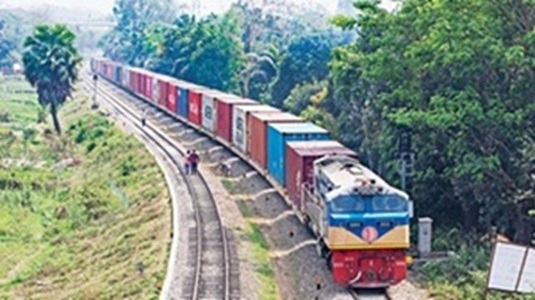
Rail freight in Bangladesh has strong potential, but realizing it depends more on management reform than on infrastructure alone. While Bangladesh Railway has a strategic advantage in transporting bulk goods efficiently and sustainably, this advantage is not fully realized due to management and operational weaknesses. Rail freight will grow when it is managed as a business, supported by public infrastructure, and driven by customer demand. 
Circular Rail Freight Line for Chattogram Port

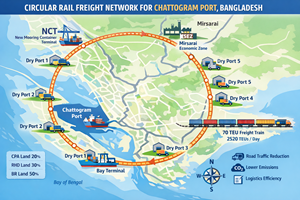
This project proposes a Circular Rail Freight Line dedicated primarily to container movement around Chattogram Port, connecting 2 major container terminals, at least 8 dry ports, and Mirsarai EPZ. The circular configuration ensures continuous flow, operational redundancy, and resilience against disruptions.